by Karen Petrauskas | Mar 12, 2026
Small business owners – Promoting your course without the overwhelm: 10 actionable strategies for success
Promoting your course can feel like a maze with too many paths and no clear direction. You’ve put in the work to create valuable content, but reaching the right audience without stress often feels out of reach. This guide breaks down ten simple, practical strategies to help you promote your course confidently while keeping things manageable.
Getting started: why promotion doesn’t have to be painful
If you’ve just launched an online course, first things first: well done. That’s no small feat. But now comes the part that trips up so many brilliant business owners: getting your course in front of the right people. The good news? It doesn’t have to be a stressful scramble. With a clear plan and a bit of consistency, you can promote your course in a way that feels natural and sustainable. For a broader look at what’s working for course creators right now, this resource is a great starting point.
Let’s walk through ten practical strategies that will help you do exactly that.
10 ways to promote your course (without the overwhelm)
#1 Start with your email list
Your email list is genuinely your most valuable marketing asset. These are people who’ve already put their hand up and said, “yes, i’m interested in what you have to say.” that’s huge.
When you’re ready to launch, don’t just send one email and hope for the best. Build a proper launch sequence that tells your story, explains what students can expect, and communicates the real change your course can bring to their lives or businesses.
Here are a few things that work well:
- Offer early-bird pricing or exclusive bonuses to reward your loyal subscribers
- Segment your list so you’re speaking directly to the people most likely to benefit
- Use clear calls-to-action and keep an eye on your open and click rates so you can refine things as you go
Your list is gold. Treat it that way.
#2 Be strategic with social media
Here’s a tip that’ll save you a lot of energy: don’t try to be everywhere at once. Pick one or two platforms where your ideal students actually spend their time, and focus your efforts there.
Think about the kind of content that performs well on those platforms. Behind-the-scenes glimpses of your course creation process, student testimonials, and short educational clips all tend to do well. Going live with a Q&A or a mini-training related to your course topic is also a brilliant way to build connection and trust.
Use the features each platform offers, whether that’s reels, stories, carousels, or polls. And remember, consistency beats frequency every single time. Showing up regularly and authentically will always outperform a flurry of posts followed by silence.
#3 Create free content that delivers real value
Before someone spends money with you, they want to know you’re worth it. Free content is how you show them.
Write blog posts, record podcast episodes, or host webinars on topics that relate to your course. Offer free downloads, checklists, or templates that solve a real problem for your audience. At the end of that content, include a natural, relevant invitation to find out more about your course.
This approach does two things at once: it builds trust with potential students, and it improves your SEO by driving organic traffic to your website. It’s one of the most sustainable ways to promote your course over the long term.
#4 Collaborate and cross-promote
You don’t have to do this alone, and honestly, you shouldn’t try to. Partnering with complementary businesses or creators can open your course up to a whole new audience.
Think about guesting on podcasts, writing for other blogs, or co-hosting a webinar with someone whose audience would benefit from your course. Joint Instagram lives are another great option, especially when both parties bring genuine value to the conversation.
The key here is to focus on mutual benefit and authentic connection. Nobody wants to feel like they’re being used as a billboard. When the collaboration feels natural and valuable for everyone involved, that’s when the magic happens.

#5 Use testimonials and social proof
People trust people. It’s as simple as that. Real feedback from students, beta testers, or clients is one of the most persuasive things you can put on your sales page or social media.
Feature testimonials and reviews prominently. If you can get video snippets, even better. Create a dedicated section on your website for student success stories, and encourage your students to share their wins publicly and tag your business when they do.
Research into social proof in digital marketing consistently shows that it has a significant impact on purchasing decisions. So don’t be shy about asking for and sharing that feedback.
#6 Optimise your landing page
Your landing page is doing a very important job: it’s your digital salesperson, working around the clock to convert visitors into students. It needs to be good.
Start with a headline that speaks directly to the outcome your course delivers. Focus on benefits rather than just features. Answer the questions your potential students are likely to have, and address any objections head-on.
Make sure your calls-to-action are clear and your enrolment process is as straightforward as possible. If signing up feels complicated, people will drop off. Check out these landing page best practices to see what high-converting pages actually look like in practice.
A well-crafted landing page can make a significant difference to your conversion rate, so it’s worth investing time here.
#7 Offer time-sensitive incentives
A little bit of urgency goes a long way. When people know an offer won’t last forever, they’re far more likely to take action sooner rather than later.
Consider launching with a limited-time discount, a bonus module, or an exclusive resource that’s only available during your launch window. Use countdown timers on your sales page and include reminders in your email sequence.
Be clear about what the deadline is and what makes your offer special. Urgency works best when it’s genuine, so make sure any time-sensitive incentives you offer are real.
#8 Engage in online communities and groups
Your ideal students are already gathering in communities online. Facebook groups, LinkedIn communities, and industry forums are all brilliant places to build visibility and trust.
The approach here is simple: show up, be helpful, and build genuine relationships. Answer questions, share useful insights, and contribute to conversations without constantly pushing your course. When the time is right and it’s relevant, you can share what you offer. But value always comes first.
This kind of community engagement takes a bit of patience, but the connections you build are often far more meaningful than anything you’d get from a paid advert.
#9 Repurpose and recycle your content
You’re already creating content, so let’s make sure you’re getting as much mileage out of it as possible.
A single blog post can become a short video, an infographic, a series of social media posts, or a section of your email newsletter. Course snippets make great teasers on social media. A webinar recording can be repurposed into a podcast episode or a series of clips.
Consistent messaging across multiple formats reinforces your course’s value and keeps it in front of your audience in different ways. You don’t always need to create something new from scratch. Work smarter with what you’ve already got.
#10 Track, learn, and refine
This one is often overlooked, but it’s genuinely important. Promotion isn’t a set-and-forget activity. It’s an ongoing process of testing, learning, and improving.
Keep an eye on your analytics. Which emails are getting the most opens and clicks? Which social posts are driving the most engagement? Which offers are converting? Survey new students to find out how they heard about you.
Use that information to make better decisions going forward. Double down on what’s working, let go of what isn’t, and keep refining your approach over time. The more you understand your audience and what resonates with them, the more effective your promotion will become.
Pulling it all together
Promoting your course doesn’t have to feel like an uphill battle. When you break it down into manageable steps and focus on building genuine connections with your audience, it starts to feel a lot less daunting.
You don’t need to do all ten of these strategies at once. Start with the ones that feel most natural to you, build from there, and give yourself permission to learn as you go. Consistency and authenticity will always take you further than trying to do everything perfectly from day one.
Ready to promote your course with confidence?
If you’re feeling ready to take action but would love some personalised support along the way, Karen’s 1-2-1 coaching programme could be exactly what you need. Over three months, you’ll work together to create a bespoke marketing plan that fits your business and your goals, with the kind of accountability and guidance that makes a real difference.
You’ve got something genuinely valuable to share. Let’s make sure the right people get to see it, without the overwhelm.
Get in touch to start a conversation and write the roadmap to your course success

by Karen Petrauskas | Jan 16, 2026
The new year is the perfect time for a fresh start, and that includes your social media presence.
If you’re a business owner looking to get more out of your online marketing in 2026, now’s the moment to strip back the noise, return to strategy, and set clear, purposeful goals for where you’re heading and why.
Why Decluttering Your Socials Matters
Over time, social media channels can become cluttered with outdated posts, off-brand content, and scattered messaging. This digital clutter doesn’t just make your feeds messy, it can dilute your brand, confuse your audience, and drain your energy. Starting the year with intention means giving yourself space to focus on what truly matters and aligning your online presence with your business ambitions.
Step #1: Audit Your Social Media Profiles
Begin with a thorough review of every channel you use: LinkedIn, Facebook, Instagram, X, Pinterest, or anywhere else your brand shows up.
Check profile bios and images: Are they up to date, on-brand, and clearly communicating who you are?
Review pinned posts and highlights: Are these still relevant and showcasing your best work?
Look at your content mix: Is it balanced between value, promotion, and personality?
Remove or update outdated information: Delete old offers, expired events, or anything that no longer serves your audience.
Step #2: Clarify Your Business Goals for 2026
Social media should serve your business, not the other way around. Take time to answer:
What are your top three business goals for this year?
How can social media support each of these goals?
What does success look like; more leads, higher engagement, increased brand awareness, or something else?
Step #3: Revisit Your Audience and Messaging
Your ideal audience may have shifted in the past year. Make sure you’re still speaking their language:
Update your ideal customer profile:
Who are you trying to reach now?
Check your tone and topics:
Are you addressing their current needs, pain points, and aspirations?
Refine your core message:
What’s the one thing you want every follower to remember about your brand?
Step #4: Set Purposeful Content Pillars
Go back to the strategy board and build your content plan around 3-5 key pillars that support your business goals and audience needs. Ideas might include:
- Educational tips and how-to’s
- Behind-the-scenes insights
- Client stories or testimonials
- Industry news or trends
- Personal reflections and founder stories
These pillars will guide your content creation and keep your messaging clear and consistent.
Step #5: Create an Actionable Content Calendar
Map out your next three months with intentionality:
Plan themes for each month or week (e.g., goal setting in January, spring refresh in March)
Schedule key campaigns or launches
Mix in evergreen and seasonal content
Leave space for spontaneous, authentic updates
Using a simple spreadsheet or scheduling tool will help you stay organised and accountable.

FREE DOWNLOAD!
Step #6: Declutter Your Following and Engagement
Quality beats quantity. Take time to:
Unfollow or mute accounts that no longer inspire or serve your business
Remove fake or inactive followers (if your platform allows)
Focus on engaging with people and brands that align with your values and goals
Start conversations, meaningful engagement is more valuable than passive scrolling
Step #7: Measure What Matters
Don’t get distracted by vanity metrics. Instead, track:
- Engagement rates (comments, shares, saves)
- Website traffic from social media
- Leads or enquiries generated
- Sales or bookings linked to your channels
Review these numbers monthly and adjust your strategy as needed.
Step #8: Set Boundaries and Healthy Habits
Social media should work for you, not the other way around. Protect your time and energy:
Block out time for content creation and engagement
Schedule regular digital detoxes or screen-free days
Use tools to automate where possible, but keep space for real connection
Ready to Align Your Ambition With Strategy?
Decluttering your socials is more than a tidy feed, it’s thinking deeper, running your business with purpose, clarity, and confidence.
When you start the year with intention, you set yourself up for growth that feels good and sustainable.
*If you’re reading this post mid-year, there’s never a wrong time to get started!
Need a helping hand? Book a Social Media Power Hour with KJP Creative.
Spend an hour dedicated to your social media channels, realigning your ambition with a strategy that works for you. We’ll audit your profiles, clarify your goals, and build a plan that sets you up for success in 2026.
Ready to make this your most intentional year yet? Let’s get started!
If you’re ready to strip back to the basics and build a social media presence that truly supports your business, book your Social Media Power Hour today, or consider our 3-month 1-2-1 coaching package to dig deeper and ensure a great year and beyond!
Speak soon!
PS – Discover more ways to elevate your presence in our Social Media tips for small business owners article.


by Karen Petrauskas | Dec 10, 2025
If you’re looking for a stress-free Christmas, here’s a simple guide to scheduling your social media content well.
The festive season is just around the corner, and for many business owners, that means a well-deserved break. But before you hang up your laptop and reach for the mince pies, there’s one task that will make your holiday so much smoother: scheduling your social media content in advance.
If you want your business to stay visible and engaged, without you being glued to your phone on Christmas Day, now’s the perfect time to get organised. Here’s your step-by-step guide to getting your social media scheduled before the Christmas break, so you can truly relax and enjoy the festivities.
Why Schedule Your Social Media Before the Holidays?
1. Stay Visible While You’re Away
Your audience doesn’t stop scrolling just because you’re taking a break. Scheduling content in advance keeps your brand top of mind, even when you’re offline. Consistent posting shows reliability and keeps your business present in your followers’ feeds.
2. Reduce Last-Minute Stress
The run-up to Christmas is always busy, both personally and professionally. By batching and scheduling your posts now, you avoid frantic, last-minute content creation. No more logging in from family gatherings or worrying about what to post next.
3. Keep Engagement High
Consistent, timely posts encourage ongoing engagement. A mix of festive posts, helpful tips, and light-hearted content keeps your community interacting and your brand approachable.
How to Get Ahead: Your Action Plan
Step 1: Plan Your Content Calendar
Map out key dates: Christmas, Boxing Day, New Year’s, and any business-specific events.
Decide what you want to share: festive greetings, year-in-review highlights, special offers, or behind-the-scenes moments.
Use a spreadsheet, digital calendar, or project management tool to visualise your plan.
Step 2: Batch Create Your Content
Block out a few focused hours to write, design, and prep all your posts for the holiday period.
Create a variety of content: images, videos, stories, and carousels.
Write captions and gather hashtags in advance.
Step 3: Use Scheduling Tools
Platforms like Buffer, Hootsuite, Later, or Facebook’s native scheduler make it easy to queue up your posts.
Schedule posts for optimal times (check your analytics for when your audience is most active).
Double-check that all links, images, and tags are working.
Step 4: Prep Your Stories & Reels
Stories and Reels are great for quick, authentic updates.
Schedule reminders for yourself to post spontaneous content, like a festive team selfie or a thank you message.
Use templates to speed up creation and keep your branding consistent.
Step 5: Set Up Auto-Replies
Update your inboxes with festive auto-replies. Let customers know when you’ll be back and how they can reach you in an emergency.
Include a warm Christmas message and a link to helpful resources or FAQs.

Book a Social Media strategy power hour. Gain clarity and insight to grow and scale your business.
Festive Content Ideas to Keep Your Feed Fresh
- Festive Polls: Ask your audience fun, seasonal questions to boost interaction.
- Year-in-Review Highlights: Share your business wins, milestones, or favourite moments from the year.
- Thank You Posts: Show gratitude to your clients, followers, and team.
- Holiday Tips: Offer advice relevant to your industry, think survival tips, end-of-year checklists, or planning for the new year.
- Behind-the-Scenes: Give a peek at how your team is celebrating or winding down for the year.
Pro Tips for Stress-Free Holiday Posting
- Reuse and Repurpose: Don’t reinvent the wheel. Repurpose your top-performing content from earlier in the year with a festive twist.
- Keep It Light: The holidays are a time for joy. Mix in fun, light-hearted content alongside your usual value-driven posts.
- Monitor and Engage (lightly): If you can, set aside a few minutes every couple of days to check notifications and respond to comments. This keeps your engagement up without taking over your break.
SEO Tips to Boost Your Christmas Social Media Posts
- Use relevant and helpful keywords that your audience will be searching for
- Add hashtags relevant to the season and your industry.
- Include a call to action in every post (e.g., “Comment your favourite Christmas tradition!” or “Book a January strategy call now!”).
- Link back to your website or blog for more tips and resources.
Your Holiday Social Media Checklist
- Plan your content calendar
- Batch create posts and visuals
- Schedule posts with a reliable tool
- Prep stories and reels
- Set up festive auto-replies
- Prepare a few minutes for light engagement

Enjoy Your Break, You’ve Earned It!
By scheduling your social media before the Christmas break, you’re giving yourself the gift of peace of mind. Your business stays visible, your audience stays engaged, and you get to enjoy a stress-free holiday knowing everything is taken care of.
If you need help planning or scheduling your social media, KJP Creative is here to support you. Let’s finish the year strong and set your business up for a successful new year!
Wishing you a relaxing, joy-filled Christmas break, your business will be shining online while you recharge offline!
For more strategies to grow your business on social, don’t miss our post on how to boost your social media performance.

by Karen Petrauskas | Nov 6, 2025
How to Measure What Actually Matters in Social Media Marketing
Come on, reality check – you’re spending hours creating content, engaging with your audience, and showing up consistently on social media. But here’s the question: Is it actually working?
If you’ve ever felt frustrated trying to prove the value of your social media efforts, we hear you. Many business owners find themselves caught in the trap of celebrating likes and followers while their bank account tells a different story.
It’s time for an ROI reality check.
Let’s cut through the noise and focus on measuring what actually matters for your business growth.
Why Vanity Metrics Are Holding You Back
We’ve all been there, getting excited about hitting 1,000 followers or seeing a post get 50 likes. These numbers feel good, but the truth is that vanity metrics don’t pay the bills.
Likes, followers, and impressions are called vanity metrics for a reason. They look impressive on paper, but they don’t tell you whether your social media marketing is contributing to your bottom line.
Think about it this way: Would you rather have 10,000 followers who never buy from you, or 500 engaged followers who regularly become customers? The answer is obvious when you put it like that.
What Social Media ROI Actually Means
Social media ROI (Return on Investment) is the measure of how much value you’re getting from the time, money, and effort you invest in your social media marketing.
The basic formula is simple:
ROI = (Revenue from social media – Cost of social media marketing) ÷ Cost of social media marketing × 100
But here’s where it gets interesting. Revenue isn’t always immediate or directly trackable. Sometimes social media contributes to your business in ways that don’t show up as an instant sale, and that’s okay, as long as you know how to measure it properly.
The Metrics That Actually Matter
Let’s take a look at the numbers which genuinely impact your business growth. These are the metrics worth tracking:
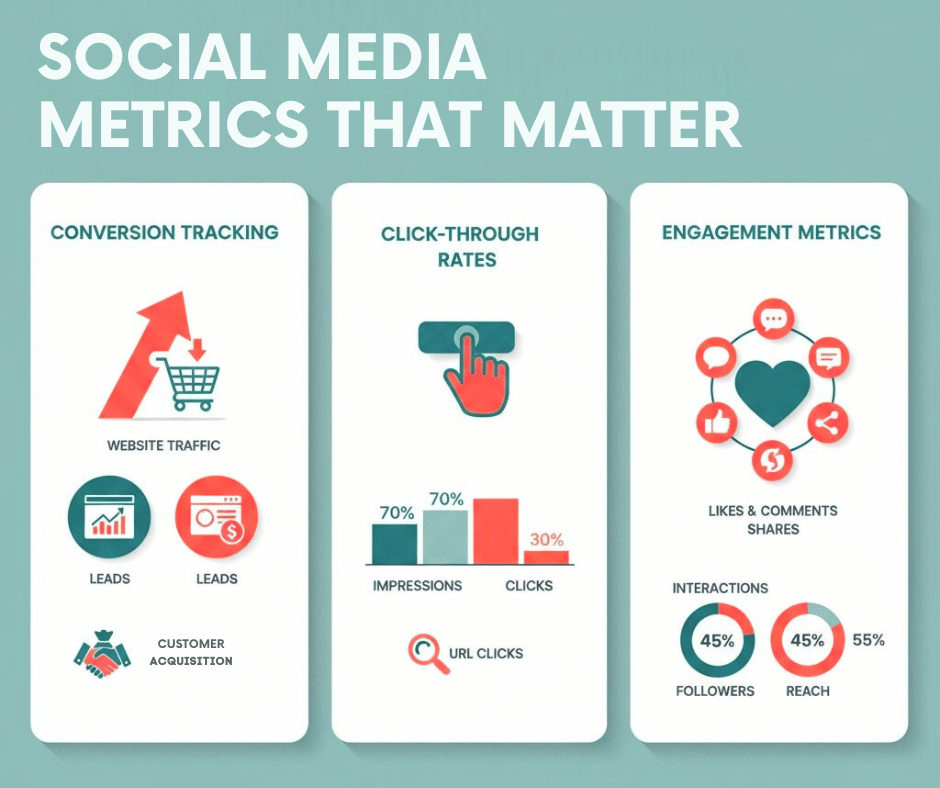
1. Conversion Rate
This is the percentage of people who take a desired action after engaging with your social media content. That action might be:
- Filling out a contact form
- Signing up for your email list
- Downloading a resource
- Making a purchase
- Booking a consultation
How to track it: Use UTM parameters in your social media links and monitor conversions in Google Analytics. Most social platforms also offer native conversion tracking through their business tools.
2. Click-Through Rate (CTR)
CTR measures how many people click on your links compared to how many see your content. A high CTR means your content is compelling enough to drive action.
What’s a good CTR? Industry averages vary, but for organic social media posts, anything above 1-2% is solid. For paid ads, aim for 2-5% or higher depending on your platform.
3. Cost Per Lead (CPL)
If you are running paid social media campaigns, the CPL tells you how much you are spending to acquire each new lead.
How to calculate it: Total ad spend ÷ Number of leads generated
This metric helps you understand whether your social media advertising is cost-effective compared to other marketing channels.
4. Customer Acquisition Cost (CAC)
CAC takes it one step further by showing you how much it costs to acquire an actual paying customer through social media.
How to calculate it: Total social media marketing costs ÷ Number of new customers acquired
Compare this to your customer lifetime value (CLV) to ensure you’re profitable.
In reality, the customer lifetime value should sit at least 3 times your customer Acquisition cost.
5. Engagement Rate
While engagement alone isn’t enough, quality engagement matters. Look at:
- Comments (especially meaningful conversations)
- Shares and saves
- Direct messages and enquiries
- Time spent on your content
How to calculate engagement rate: (Total engagements ÷ Total followers) × 100
A strong engagement rate indicates you’re building relationships, not just broadcasting messages.
6. Website Traffic from Social Media
How many people are visiting your website from your social media channels? More importantly, what are they doing once they get there?
Track these details:
- Which social platforms drive the most traffic
- Which pages visitors land on
- How long they stay on your site
- What actions they take (bounce rate, pages per session)
7. Lead Quality and Sales Attribution
Not all leads are created equal. Track where your highest-quality leads come from and which social media efforts contribute to actual sales.
Use multi-touch attribution to understand how social media fits into your customer journey. Often, social media plays a crucial role in awareness and consideration, even if the final conversion happens elsewhere.
Want to dig deeper? We can walk you through it.
Practical Tools for Tracking Social Media ROI
You don’t need expensive software to start measuring effectively. Here are practical tools to get you started:
Free Tools:
Google Analytics: Essential for tracking website traffic, conversions, and user behaviour from social media
Native Platform Analytics: Facebook Insights, Instagram Insights, LinkedIn Analytics, and Twitter Analytics all provide valuable data
UTM Parameters: Create trackable links using Google’s Campaign URL Builder
Paid Tools (Worth Considering):
Hootsuite or Social Pilot: Social media management with built-in analytics
Sprout Social: Comprehensive reporting and ROI tracking
HubSpot: Full marketing automation with social media ROI capabilities
How to Set Up Your Tracking System
Ready to implement proper ROI tracking? Follow these steps:
Step 1: Define Your Goals
What does success look like for your business? Be specific:
- Generate 10 qualified leads per month
- Drive 500 website visits from social media
- Achieve £5,000 in trackable revenue from social campaigns
Step 2: Set Up Conversion Tracking
Install tracking pixels from your social platforms on your website.
Set up goals in Google Analytics for key actions (form submissions, purchases, downloads).
Step 3: Create a Tracking Spreadsheet
Document your monthly metrics in one place:
- Total social media costs (time + money)
- Website traffic from each platform
- Leads generated
- Conversions and revenue
- Calculate your ROI
Step 4: Review and Adjust Monthly
Set aside time each month to review your numbers. Ask yourself:
- Which platforms are delivering the best ROI?
- Which content types drive the most conversions?
- Where should you invest more time and resources?
- What’s not working and should be cut?
The Reality of Social Media ROI
Here’s something important to remember: social media ROI isn’t always immediate. Building trust, awareness, and relationships takes time. Some of your best customers might follow you for months before they’re ready to buy.
That’s why tracking the full customer journey matters. Use CRM systems or simple spreadsheets to note how customers first discovered you. You might be surprised how many say “I’ve been following you on Instagram for ages!”
Making ROI Work for Your Business
The goal isn’t to become a data analyst, it’s to make informed decisions that grow your business.
Start with the basics:
- Track website traffic from social media
- Monitor lead generation
- Calculate your basic ROI monthly
- Adjust your strategy based on what the numbers tell you
Remember, the best social media strategy is one that delivers real business results, not just impressive-looking numbers that don’t translate to growth. Once you know what’s working, learn how to create social media content that converts.
Your Next Steps
Stop guessing whether your social media marketing is working. Start measuring what matters:
- Set up Google Analytics if you haven’t already
- Create trackable links for your social media posts
- Define 3-5 key metrics you’ll track monthly
- Schedule a monthly ROI review in your calendar
Social media marketing should contribute to your business growth in measurable ways. When you focus on the right metrics, you’ll have the clarity and confidence to invest your time and budget where it actually makes a difference.
Need help creating a social media strategy that delivers measurable ROI? That’s exactly what we do at KJP Creative. Let’s talk about how we can help you turn your social media presence into a genuine business asset.

by Karen Petrauskas | Jun 30, 2025
How to Stand Out and Grow Online
In today’s digital world, people don’t just buy products, they buy into people. That’s why personal branding is one of the most powerful tools small business owners can use to grow their business, build trust, and stand out in a crowded market.
Whether you’re a solo entrepreneur or the face of a growing brand, your personal brand is what sets you apart. It’s how people connect with you, remember you, and decide to do business with you.
Let’s explore how to build a personal brand that feels authentic, builds real connections, and helps your business thrive.
🌟 What Is Personal Branding (and Why It Matters)?
Personal branding is how you present yourself to the world, online and offline. It’s your voice, your values, your story, and how you show up consistently across platforms.
For small business owners, your personal brand is often the first impression people get. It’s what makes your business feel human and relatable.
Why it matters?
- Builds trust and credibility
- Helps you attract the right audience
- Makes your business more memorable
- Opens doors to new opportunities (collabs, media, speaking gigs)
💬 Be Real, Authenticity Wins
People want to connect with real people, not polished perfection. Being authentic means showing up as yourself, sharing your journey, and being honest about the ups and downs.
Try this…
- Share behind-the-scenes moments
- Talk about your “why” and what drives you
- Let your personality shine in your content
- Don’t be afraid to show the messy middle
- Authenticity builds emotional connection. And connection builds loyalty.
🤝 Build Relationships, Not Just Reach
It’s easy to get caught up in numbers, followers, likes, views. But real growth comes from real relationships.
Focus on…
- Starting conversations, not just posting
- Replying to comments and DMs
- Asking your audience questions
- Showing appreciation to your community
- When people feel seen and heard, they stick around, and they tell others about you.
🎯 Know What Makes You Different
Your personal brand should highlight what makes you you. What do you bring to the table that others don’t?
Ask yourself…
- What do my customers love most about working with me?
- What values guide my business?
- What’s my unique story or perspective?
- Once you know your unique value, weave it into everything, from your Instagram bio to your website copy.
📖 Tell Your Story
Storytelling is one of the most powerful tools in branding. It helps people understand who you are and why you do what you do.
Share stories like…
- How you started your business
- A challenge you overcame
- A customer success story
- A moment that shaped your mission
- Make your audience the hero. Show how your product or service helps them solve a problem or reach a goal.
🧩 Stay Consistent
Consistency builds trust. When your message, tone, and visuals are aligned, people know what to expect, and that builds confidence in your brand.
Tips for staying consistent…
- Use the same profile photo and bio across platforms
- Stick to a clear brand voice (fun, professional, bold, whatever fits you)
- Create a simple brand style guide (colours, fonts, tone)
- Plan your content in advance so your message stays on track
📈 Show Up and Stay Visible
You don’t need to be everywhere, but you do need to show up regularly where your audience is.
Ways to stay visible…
- Post consistently on your main platform
- Show your face in Stories or Reels
- Share value-packed tips, insights, or behind-the-scenes content
- Collaborate with others in your niche
- The more people see you, the more they remember you, and the more they trust you.
✨ Final Thoughts
Your personal brand is your superpower. It’s what makes your business feel human, relatable, and trustworthy. You don’t need to be perfect, you just need to be you, consistently.
Start small. Pick one platform. Share one story. Connect with one person. Over time, those small steps build a brand that people love, and a business that grows.
If you’re not sure how to make the shift necessary to get your branding on track, reach out and let’s talk.
In the meantime, why not download our FREE Social Media Checklist – Don’t Forget the Basics, to get you thinking over your social media channels.
Speak soon!